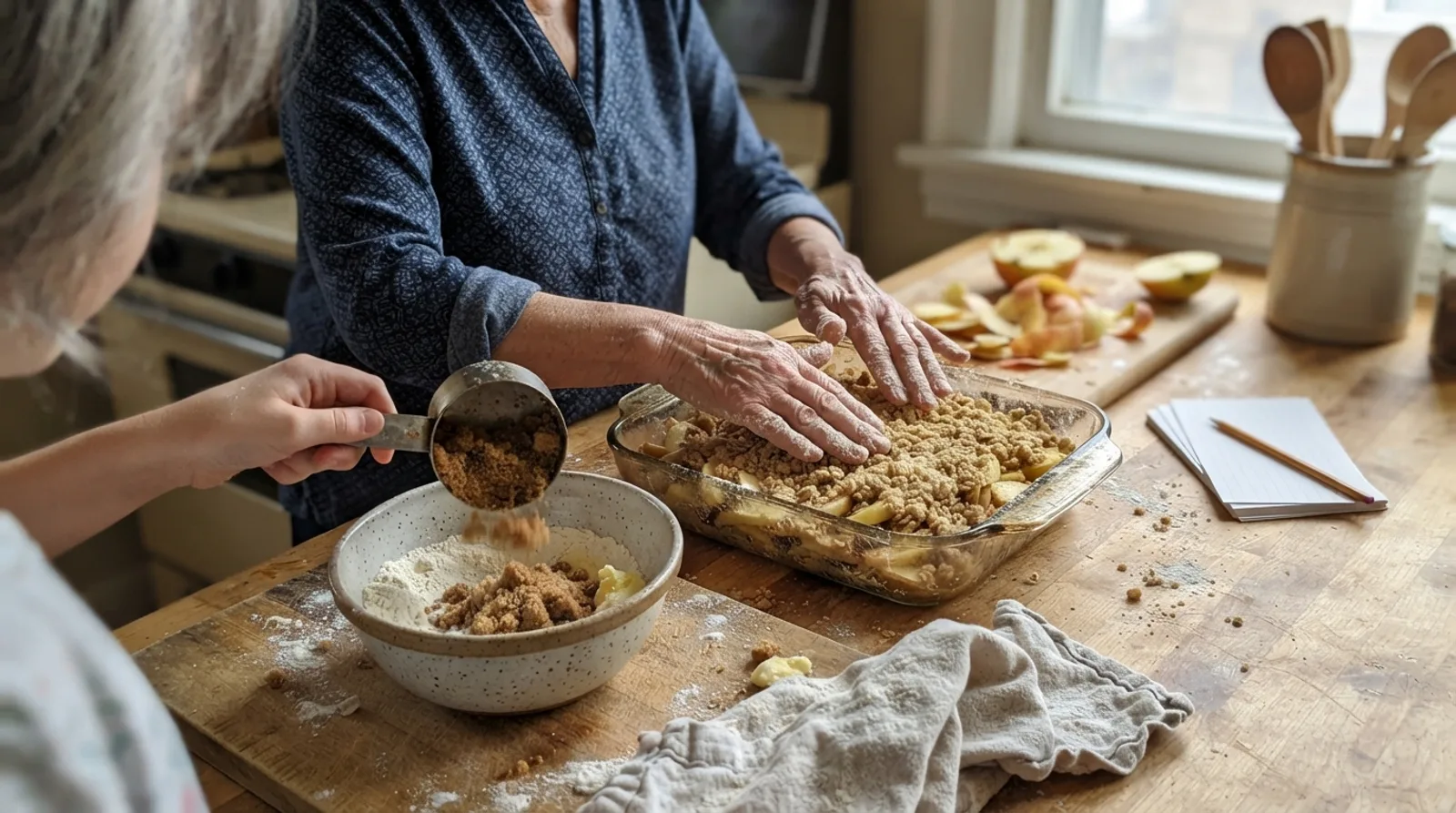
Maybe it is the chili you make without thinking, a cake your friends keep asking for, or your grandmother's apple crisp that has only ever lived in her hands. Writing it down sounds easy until someone else tries to cook from your notes and texts you three questions before the oven is even on.
A good recipe answers those questions before anyone asks them. This guide gives you the format cookbooks and recipe sites use, the rules for ingredients and steps that make a recipe easy to follow, and a free recipe card maker below that turns your rough notes into a clean card you can copy or print.
The standard recipe format
Almost every published recipe follows the same order, because it matches the order a cook needs things: what is this, how much does it make, what do I need, what do I do. Stick to it and anyone who has used a cookbook will know where to look.
- 1
Title
The name you actually call it, with the main ingredient in it: "Grandma's Apple Crisp" tells a reader more than "Fall Dessert". - 2
Headnote
One to three sentences on where the recipe comes from or why it works. Optional, but it is where a family recipe keeps its story. - 3
Yield and time
Serves 6, or makes 24 cookies. Then prep time and cook time, so the reader knows if it fits a weeknight. - 4
Ingredients
One per line, in the order the steps use them, each with an amount. - 5
Steps
Numbered, one action each, with heat, time and a sign that it is done. - 6
Notes
Swaps, make-ahead and storage tips, and anything you learned the hard way.
Turn your notes into a recipe card
Paste a recipe the way you would jot it in your phone, or start from the blank template. The card maker sorts out the title, ingredients and steps, writes every unit the same way, splits a run-on paragraph into numbered steps, and then checks the result against the rules in this guide. The sample is a real kind of family note: it looks complete until you try to bake from it.
Recipe card maker
Grandma's Apple Crisp
Serves ? · Time ?
Ingredients
- 6 apples sliced
- 1 cup flour
- 3/4 cup brown sugar
- 1/2 cup oats
- 1 tsp cinnamon
- pinch of salt
- 1/2 cup butter, cold
- 1 tbsp lemon juice
Steps
- 1.Put apples in the pan and toss with lemon juice.
- 2.Mix flour, sugar, cinnamon and salt then cut in the butter til crumbly.
- 3.Sprinkle over apples.
- 4.Bake till bubbly.
6 things to add before someone else can cook from it
- Says how much it makesAdd a line like "Serves 6" or "Makes 24 cookies".
- Every ingredient appears in the stepsNever mentioned: 1/2 cup oats. Say when it goes in.
- Ingredients listed in the order you use themUsed earlier than listed: 1 tbsp lemon juice.
- Oven temperature, set firstAdd the temperature, like "Heat the oven to 375°F".
- Pan size namedName the pan, like "8 x 8 inch baking dish". Bake time depends on it.
- Cooking steps give a time and a sign it's doneAdd a time to step 4.
- Units written one wayEvery unit on the card is now written the same short way (tsp, tbsp, cup).
- One action per stepYour paragraph is now numbered steps.
- A clear title
- Every ingredient has an amount
How to write the ingredient list
The ingredient list is a shopping list and a prep list at the same time, so it has to be complete and exact. Food writers agree on a handful of rules, and The Daily Meal's guide to recipe writing sums them up well.
- List in the order of use. The cook reads down the list as they work, so the first thing in the pot is the first thing on the list.
- Amount, unit, ingredient, prep. "2 tbsp olive oil", "1 large onion, diced", "3 cloves garlic, minced". Put the prep in the list, not in the middle of the steps, so it gets done before the heat is on.
- Mind where the comma goes. "1 cup chopped cilantro" means chop, then measure. "1 cup cilantro, chopped" means measure, then chop, which is much less cilantro.
- Include everything. Salt, oil for the pan and water count as ingredients too. Anything without a set amount still gets a line: "salt and pepper, to taste".
- Pick one way to write units. Either "tablespoon" or "tbsp", never both on one card. For baking, grams beside cups make a recipe far easier to repeat.
Ingredients used more than once: write "divided"
If sugar goes into both the filling and the topping, list it once with the total and the word divided: "1 cup sugar, divided". The steps then say how much goes in each time, "half of the sugar" and "the remaining sugar", the convention in the Guiding Stars recipe style guide. For a recipe with distinct parts, such as a crust and a filling, split the list under small headings ("For the crust", "For the filling") and use the same headings in the steps.
Hard to cook from
some flour
butter
cinnamon, salt
a handful of oats
Easy to cook from
1 cup all-purpose flour
½ cup cold butter, cubed
1 tsp ground cinnamon
½ cup rolled oats
How to write recipe steps people can follow
Steps are where most home recipes fall apart, usually because the writer knows things the reader does not. Write them for someone cooking the dish for the first time, in a kitchen they do not know.
- 1
Put waiting jobs first
Preheating the oven, boiling pasta water and softening butter take time, so they belong in step 1, not halfway down. - 2
One action per step, verb first
"Whisk the flour, sugar and salt in a large bowl." Start a new step when the pan, the method or the group of ingredients changes. - 3
Give heat, time and a sign it is done
"Cook over medium heat for 5 to 7 minutes, until the onions are soft and golden." Ovens and stoves vary, so the sign matters as much as the clock. - 4
Name the pan
Bake time depends on the size of the dish, so write "8 x 8 inch baking dish", not "a pan". - 5
Warn about the tricky bit
If garlic burns in seconds or the caramel can seize, say so in the step where it happens.
Call each thing by one name all the way through. If it is a "sheet pan" in step 2, it is not a "baking tray" in step 5. And once an ingredient is in the list as "1 cup packed light brown sugar", the steps can simply say "the brown sugar".
Heat
- Vague
- Cook the onions
- Clear
- Cook the onions over medium heat
Time
- Vague
- Bake till done
- Clear
- Bake for 35 to 40 minutes
Doneness
- Vague
- Until ready
- Clear
- Until the top is golden and the filling bubbles at the edges
Pan
- Vague
- Pour into a pan
- Clear
- Pour into a greased 9 x 13 inch pan
Amount
- Vague
- Add some of the sugar
- Clear
- Add half of the sugar
| Vague | Clear | |
|---|---|---|
| Heat | Cook the onions | Cook the onions over medium heat |
| Time | Bake till done | Bake for 35 to 40 minutes |
| Doneness | Until ready | Until the top is golden and the filling bubbles at the edges |
| Pan | Pour into a pan | Pour into a greased 9 x 13 inch pan |
| Amount | Add some of the sugar | Add half of the sugar |
Free recipe card template (printable)
The card maker above doubles as a type-and-print recipe card template. Click Blank template to start from an empty card with every section in place, replace the placeholder lines with your recipe, choose a size and click Print: only the card prints, sized to the page you picked. Copy as text gives you the same card as plain text for a notes app, an email or a document.
Best for
- 3 x 5 card
- Short recipes, dressings, drinks
- 4 x 6 card
- Most weeknight dinners and bakes
- Full page
- Long recipes and holiday projects
Fits
- 3 x 5 card
- A handful of ingredients and short steps
- 4 x 6 card
- A typical recipe on one side
- Full page
- Anything, with room for notes
Tip
- 3 x 5 card
- Continue on the back if needed
- 4 x 6 card
- The usual recipe box size
- Full page
- Punch holes for a binder
| 3 x 5 card | 4 x 6 card | Full page | |
|---|---|---|---|
| Best for | Short recipes, dressings, drinks | Most weeknight dinners and bakes | Long recipes and holiday projects |
| Fits | A handful of ingredients and short steps | A typical recipe on one side | Anything, with room for notes |
| Tip | Continue on the back if needed | The usual recipe box size | Punch holes for a binder |
To print on index cards, load them into the printer's manual or photo tray and set the paper size in the print dialog to match the card. If a long recipe runs off the card, switch to Full page. And keep one blank line under the steps for notes, because the best changes to a recipe get written in the margin after the third time you make it.
How to write down a family recipe that was never measured
The hardest recipes to write are the ones cooked by feel: a handful of this, a pour of that, "until it looks right". The only reliable way to capture them is to cook alongside the person who makes them, as SBS Food's guide to recording a family recipe recommends.
- Measure before it goes in. When they reach for a handful of flour, ask them to drop it into your measuring cup first. Weighing it on a kitchen scale is even better.
- Ask about the senses. What should it smell like when the onions are ready? How thick should the sauce be? Those answers become the signs of doneness in your steps.
- Time the steps. Start a timer on your phone at each stage. "Fry the onions" becomes "fry for about 10 minutes".
- Write down the story. Who made it first, when it gets made, what they always say while making it. That belongs in the headnote.
- Note your updates. If you swap lard for butter or use cultivated fennel instead of wild, say so in the notes and keep the original line too.
If the recipes already exist on old cards in a shoebox, start there instead: our guide to digitizing handwritten family recipe cards covers sorting, photographing and keeping them safe, and you can then rewrite the favorites in the format above.
A recipe is finished when someone who has never watched you cook can make it from the page.
Check and test your recipe before you share it
Proofreading a recipe is different from proofreading a letter. Read the ingredient list and tick off each item as you find it in the steps: an ingredient that never gets added is one of the most common mistakes in written recipes, and the card maker above flags it for you. Then read the steps for every number: temperature, time, pan size, yield.
Then hand it over. RecipeLion's Addie Gundry puts it simply in her recipe writing tips: test it, then give it to a friend or family member to make, because steps that are clear to you may not be clear to anyone else. Watch where they hesitate or text you a question, and fix the recipe at that spot.
Keep your written recipes where you can find them
Once a recipe is written, it should be somewhere you can search it from the store, scale it for a crowd and cook from it with flour on your hands. In CookEase you can paste your typed recipe into the paste box (here is how), or take a photo of a printed or handwritten card (here is how), and it becomes a recipe with its ingredients and steps separated. From there you can change the servings and every amount follows, which pairs well with our guide to doubling a recipe. Your first 5 saves are free.
Keep every family recipe in one place.
Paste a recipe or snap a photo of the card, and cook from it on any phone or computer, scaled to the servings you need.