You found the perfect recipe, and it serves four. You need it for ten, or you want a second tray in the freezer, or the recipe wants an 8 x 8 pan and all you own is a 9 x 13. Doubling looks like simple multiplication, and for most ingredients it is. The trouble lives in a short list of exceptions, and in the pan.
This guide covers both. Use the scaler below on your own recipe, then the pan converter to pick a pan that keeps the bake time honest. The sections after them explain why each exception exists, so you can scale recipes the tools have never seen.
What doubles and what doesn't
Flour, sugar, butter, liquids, vegetables, meat and pasta all scale in a straight line: twice the recipe, twice the amount. The exceptions are the ingredients that work by concentration or by chemistry rather than by bulk.
| Just multiply? | What to do instead | |
|---|---|---|
| Flour, sugar, fats, liquids | Multiply exactly. Weigh flour if you can. | |
| Meat, vegetables, pasta, beans | Multiply exactly. | |
| Salt and strong spices | Start at about 1.5x, taste, then add the rest. | |
| Baking soda and powder | Mostly | Multiply, then whisk into the dry ingredients very well. |
| Eggs | Mostly | Round to whole eggs, or beat and weigh. |
| Oil for the pan | Use enough to coat the pan, not double. | |
| Bake or cook time | Check at the original time, then every 5 minutes. | |
| Pan size | Use a pan with about twice the area (converter below). |
Scale your recipe in seconds
Paste your ingredient list, one ingredient per line, and pick how much you want. The scaler converts awkward amounts into measures you actually own (5 teaspoons becomes 1 tablespoon plus 2 teaspoons, never "1⅔ tablespoons"), rounds eggs, and flags the ingredients in the table above.
Recipe scaler
- 4½ cups all-purpose flour
- 2 tsp baking soda
- 2 tsp salt
- 2 cups butter, softened
- 1½ cups brown sugar
- 1½ cups granulated sugar
- 2 tsp vanilla extract
- 4 large eggs
- 4 cups chocolate chips
Don't just multiply these
- Leavening: scales cleanly in a batch up to double; for bigger batches bake in separate pans.
- Seasoning: add about 1.5x first, then taste and add the rest.
- Eggs: round to a whole egg, or beat one and use part of it.
Pick the right pan: it's about area, not volume
A recipe written for one pan bakes in a predictable time because the batter sits at a predictable depth. Keep the depth the same and the bake time barely moves. To keep the depth, the new pan needs the right surface area, and area is easy to work out: length times width for square and rectangular pans, and 3.14 times the radius squared for round ones.
64sq in
8 x 8 inch pan
The usual brownie pan
128sq in
A double batch needs
Twice the area, same depth
117sq in
9 x 13 inch pan
The closest common pan
That is why a doubled 8 x 8 recipe works in a 9 x 13: the pan is about 9% smaller than a perfect double, so the batter is a little deeper and usually needs a few extra minutes. Two 8 x 8 pans side by side are the exact answer if you have them.
Pan size converter
117 sq in ÷ 64 sq in = 1.83x
Double the recipe. It will sit a little deeper, so allow a few extra minutes.
Keeps the batter at the same depth, so the original bake time is your starting point. Check 5 to 10 minutes early in a bigger pan, and expect a longer bake if the batter ends up deeper.
Round pans are smaller than they look
A 9 inch round cake pan holds about 64 square inches, the same as an 8 inch square, and an 8 inch round holds only about 50. So a recipe for two 8 inch rounds (about 100 square inches) will not fill a 9 x 13 (117), and the thinner layer bakes faster. Run the numbers in the converter before you swap shapes.
Bake time and oven temperature
Bake time follows the depth of the food, not its total amount. So doubling never means doubling the time, and the oven temperature stays where the recipe puts it.
- 1
Keep the original temperature
Raising the heat to hurry a deeper pan browns the edges long before the center sets. - 2
Set a timer for the original time
If you kept the depth the same with the right pan, this is close to done. - 3
Check every 5 minutes after that
Use the recipe’s own doneness test: a toothpick with moist crumbs for brownies, a springy center for cakes, an internal temperature for meat. - 4
Tent with foil if the top darkens early
A slightly deeper batter needs more time in the middle than on top. Foil buys it that time.
One giant pan
Two normal batches
Doubling baked goods: the rules that matter
Cooking forgives; baking measures. A soup with 10% too much broth is still soup. A cake with 10% too much flour is dry. Three habits make doubled baking come out like the original.
- Weigh the flour. Scooping flour with a measuring cup packs it, and the error grows with every extra cup you scoop. Grams scale exactly; cups don't.
- Whisk the leavening into the dry ingredients. A double batch of batter is harder to mix evenly, and a pocket of baking soda tastes soapy and leaves the rest of the cake flat.
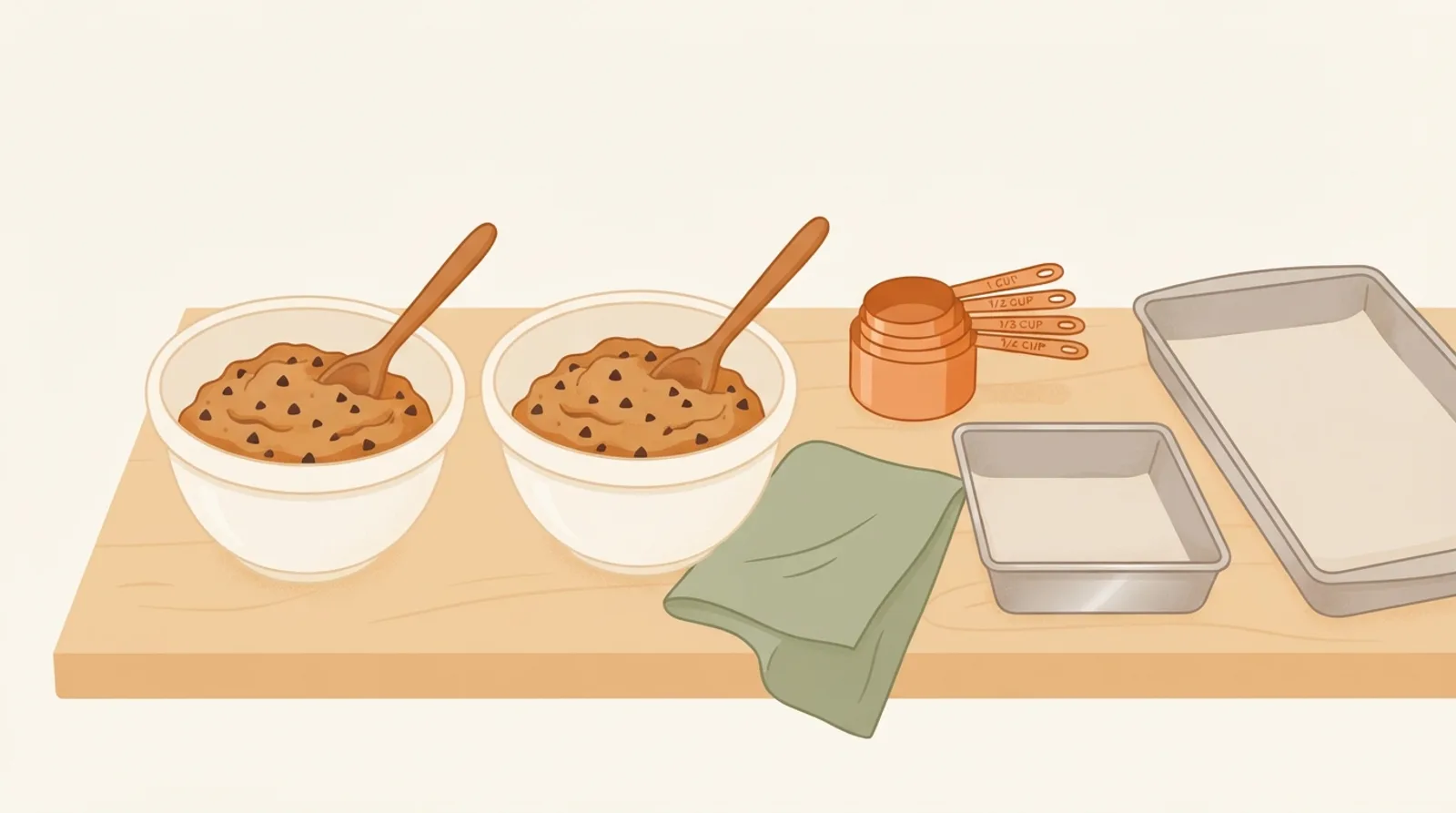
- Mind your mixer. A double batch of cookie dough can overfill a stand mixer bowl. If it climbs the paddle, mix in two rounds and combine.
Bread and other yeast doughs
Double the yeast with everything else, then shape the dough into loaves the size the recipe expects. Two normal loaves bake at the original time and temperature. One loaf twice the size needs a longer bake, often at a slightly lower temperature, so the crust does not burn before the center is done.
Cookies
Cookies are the easiest thing to double, because each cookie is still the same size. The batch is bigger, not the cookie. Bake the extra trays one at a time on the middle rack, or rotate trays halfway if you bake two at once.
Soups, stews, slow cookers and pressure cookers
Stovetop dishes double the most easily. Use a wider pot rather than a taller one so onions brown instead of steaming, and brown meat in batches: a crowded pan releases water and the meat boils gray instead of searing.
Slow cookers and electric pressure cookers have a maximum fill line marked inside the pot, and a doubled recipe often crosses it. Stay under the line, even if it means making one and a half batches. Under pressure, the cooking time depends on the size of the pieces, not the amount of food, so it stays the same. The pot takes longer to come up to pressure, though, so plan for extra time in total.
Halving a recipe (and the egg problem)
Halving follows the same rules in reverse: use a pan with half the area, check for doneness early, and season to taste. The only real puzzle is the odd egg. A large egg weighs about 50 grams out of the shell, so beat the eggs together, weigh the mixture and use half. With no scale, measure it with a spoon: a beaten large egg is about 3 tablespoons.
Scale the ingredients exactly, scale the pan by area, and never scale the clock.
Keep the scaled version
If you make a doubled recipe more than once, write the doubled amounts down so you never redo the math at the counter. In CookEase, every saved recipe has a servings control: change the servings and every ingredient amount, and the amounts written into the steps, scale with it, so you cook from a list that already matches your batch. If a recipe came from a video or a blog, save it first (here is how), then scale it. Planning a whole week around a few big batches? The 3-recipe week shows how.
Scale any recipe with one tap.
Save a recipe from any link, set the servings you need, and cook from amounts that already match your batch.