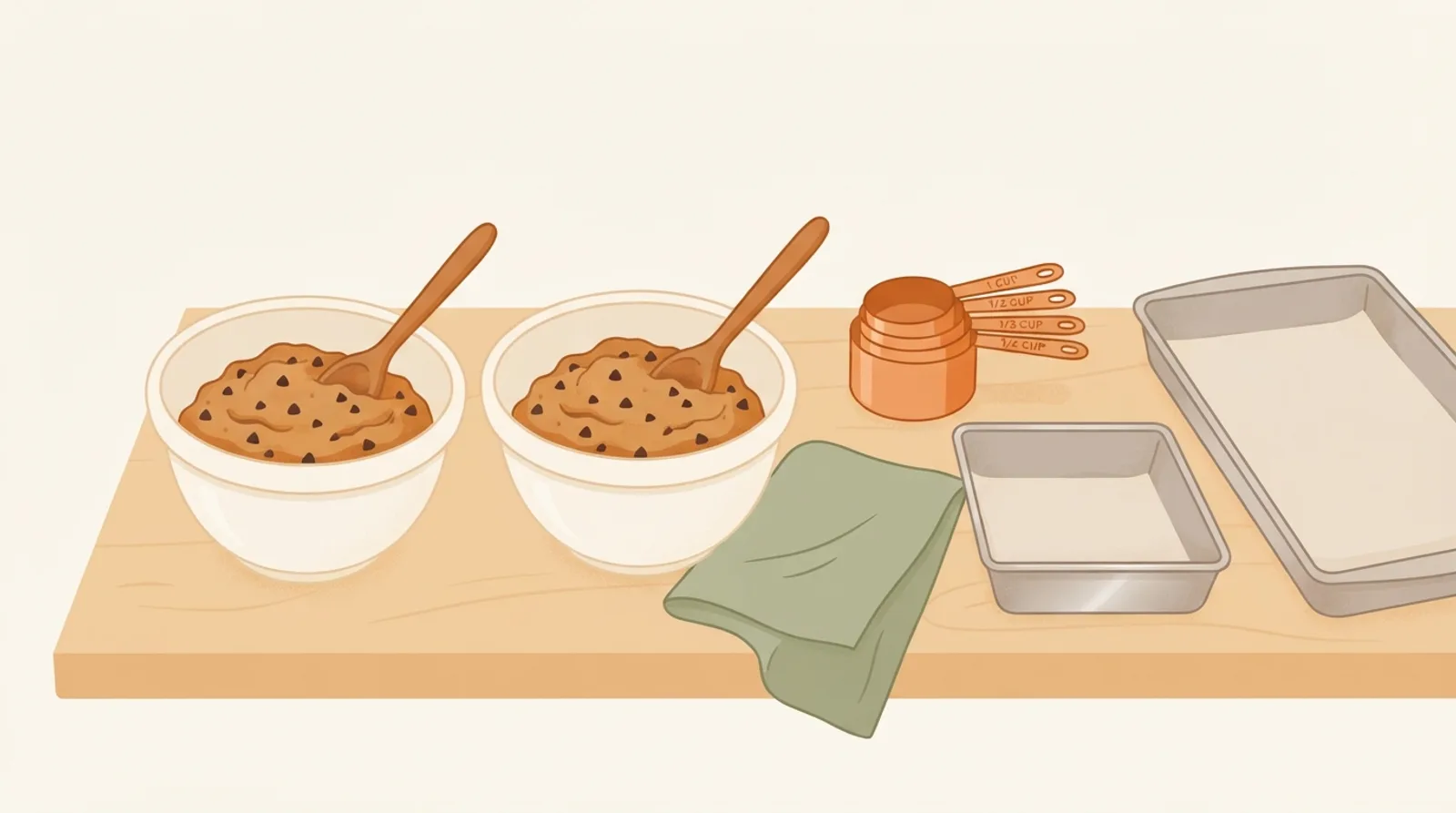
Recipe converter
Double (2x)
- 4½ cups all-purpose flour
- 2 tsp baking soda
- 2 tsp salt
- 2 cups (4 sticks) butter, softened
- 1½ cups packed brown sugar
- 1½ cups granulated sugar
- 1 tbsp vanilla extract
- 4 large eggs
- 4 cups chocolate chips
Don't just multiply these
- Salt and spices. When making more, add most of the scaled amount, taste, then add the rest. Saltiness and heat are easy to overshoot in a bigger batch.
- Baking soda and powder. Scale them exactly and whisk them into the dry ingredients so they spread evenly. Past a double batch, bake in two pans instead of one deep one.
- Pan size and time. Use a pan whose area changes by the same factor (see the pan converter below) and check for doneness early. Keep the oven temperature; the time in the recipe is where you start, never something to multiply.
The converter reads ingredient lists the way people write them: mixed numbers like 1 1/2, fraction characters like ½, ranges like 2-3 cloves, amounts glued to their units like 200g, and lines copied with bullets or checkboxes from a recipe site. Lines with no amount, like "salt to taste", stay exactly as they are. Pick By servings when you know how many people you are feeding, or By amount to halve, double, triple or type any multiplier, such as 1.5 or 3/4.
The short answer
- A recipe converter multiplies every ingredient by one number, the conversion factor: the servings you want divided by the servings the recipe makes. For 6 servings from a recipe that serves 4, the factor is 6 ÷ 4 = 1.5.
- Round the results to measures you own: 3 teaspoons make 1 tablespoon, 16 tablespoons make 1 cup, and half of ⅓ cup is 2 tablespoons plus 2 teaspoons.
- Grams are more reliable than cups. King Arthur Baking puts a cup of all-purpose flour at 120 grams and a cup of granulated sugar at 198 grams, so grams to cups depends on the ingredient.
- Salt, spices, leavening, eggs, pan size and bake time need judgment, not multiplication: season to taste, weigh part eggs (a large egg is about 50 grams), match the pan by area and check for doneness early.
How do I convert a recipe?
To convert a recipe, divide the servings you want by the servings the recipe makes, multiply every ingredient by that number, and round each result to a measure you can use. The number is called the conversion factor, and it is the only math the job needs.
- 1
Find the conversion factor
Servings you want ÷ servings in the recipe. A recipe for 4 made for 6 is 6 ÷ 4 = 1.5. A recipe for 12 made for 3 is 3 ÷ 12 = 0.25. - 2
Multiply every ingredient
Including the small ones. The classic mistake is doubling the flour and forgetting the baking soda, so write the whole new list before you start. - 3
Round to measures you own
1.5 times ⅔ cup is 1 cup. Half of ⅓ cup is 2 tablespoons plus 2 teaspoons. The charts below and the converter above do this rounding for you. - 4
Adjust what does not scale evenly
Salt and strong spices go in to taste, eggs get rounded or weighed, and leavening gets whisked in thoroughly. - 5
Pick the pan and check early
Use a pan whose area changes by the same factor, keep the oven temperature, and start checking for doneness before the original time is up.
Recipe conversion chart
These are the conversions people look up most, in one place. A US cup holds 16 tablespoons and a tablespoon holds 3 teaspoons. In milliliters, cooks use 240 ml for a cup, 15 ml for a tablespoon and 5 ml for a teaspoon, the rounded kitchen values published by NIST. A fluid ounce is 2 tablespoons, or about 30 ml.
| Measure | Tbsp | Tsp | Ml |
|---|---|---|---|
| 1 cup | 16 | 48 | 240 |
| ¾ cup | 12 | 36 | 180 |
| ⅔ cup | 10 tbsp + 2 tsp | 32 | 160 |
| ½ cup | 8 | 24 | 120 |
| ⅓ cup | 5 tbsp + 1 tsp | 16 | 80 |
| ¼ cup | 4 | 12 | 60 |
| ⅛ cup | 2 | 6 | 30 |
| 1 tbsp | 1 | 3 | 15 |
| 1 tsp | ⅓ | 1 | 5 |
| ½ tsp | - | ½ | 2.5 |
| ¼ tsp | - | ¼ | 1.25 |
| US weight | Grams |
|---|---|
| 1 oz | 28 g |
| 4 oz (¼ lb) | 113 g |
| 8 oz (½ lb) | 227 g |
| 12 oz (¾ lb) | 340 g |
| 16 oz (1 lb) | 454 g |
| 2 lb | 907 g |
| 2.2 lb | 1000 g |
Half of ¾ cup, ⅓ cup and other measures
Half of ¾ cup is 6 tablespoons, half of ⅓ cup is 2 tablespoons plus 2 teaspoons and half of ¼ cup is 2 tablespoons. Doubled, ¾ cup is 1½ cups. For any other single measure, halved, a third, doubled or tripled, with the fewest scoops from a measuring set and full charts, use the half and double calculator.
Grams to cups for common ingredients
There is no single number for grams to cups, because a cup measures space, not weight. A cup of flour is mostly air and weighs about 120 grams; a cup of honey weighs 336. To convert, divide the grams in the recipe by the weight of one cup of that ingredient. The converter does it for the ingredients below when you choose Cups and oz for a recipe written in grams, or Grams and ml for one written in cups.
| Ingredient | 1 cup | ½ cup | ¼ cup |
|---|---|---|---|
| All-purpose flour | 120 g | 60 g | 30 g |
| Bread flour | 120 g | 60 g | 30 g |
| Whole wheat flour | 113 g | 57 g | 28 g |
| Almond flour | 96 g | 48 g | 24 g |
| Granulated sugar | 198 g | 99 g | 50 g |
| Brown sugar (packed) | 213 g | 107 g | 53 g |
| Powdered sugar | 113 g | 57 g | 28 g |
| Butter | 226 g | 113 g | 57 g |
| Cocoa powder | 84 g | 42 g | 21 g |
| Chocolate chips | 170 g | 85 g | 43 g |
| Rolled oats | 89 g | 45 g | 22 g |
| Rice (uncooked) | 198 g | 99 g | 50 g |
| Honey | 336 g | 168 g | 84 g |
| Maple syrup | 312 g | 156 g | 78 g |
| Peanut butter | 270 g | 135 g | 68 g |
| Vegetable oil | 198 g | 99 g | 50 g |
| Milk | 227 g | 114 g | 57 g |
| Sour cream | 227 g | 114 g | 57 g |
| Shredded cheese | 113 g | 57 g | 28 g |
| Walnuts (chopped) | 113 g | 57 g | 28 g |
| Cornstarch | 112 g | 56 g | 28 g |
Weighing is also the most reliable way to scale a recipe. Grams multiply and divide without any rounding, which is why King Arthur Baking recommends switching to the gram measurements when you reduce a recipe. A scooped cup of flour packs down and weighs more than a spooned one, and that error grows with every cup you multiply.
What doesn't convert in a straight line
Most ingredients scale exactly: flour, sugar, butter, liquids, vegetables, meat and pasta all simply multiply. The exceptions are the ingredients that work by concentration or chemistry, and the pan and the clock. The converter flags them under your list.
Flour, sugar, fats, liquids
- Just multiply?
- What to do instead
- Multiply exactly, ideally by weight.
Eggs
- Just multiply?
- Mostly
- What to do instead
- Round to whole eggs, or beat and weigh the part egg.
Salt and strong spices
- Just multiply?
- What to do instead
- Add most of the scaled amount, taste, then the rest.
Baking soda and powder
- Just multiply?
- Mostly
- What to do instead
- Multiply exactly and whisk into the dry ingredients.
Yeast
- Just multiply?
- Mostly
- What to do instead
- Multiply, then watch the dough instead of the clock.
Oil for the pan
- Just multiply?
- What to do instead
- Use enough to coat the pan you are using.
Pan size
- Just multiply?
- What to do instead
- Change the pan area by the same factor.
Time and temperature
- Just multiply?
- What to do instead
- Keep the temperature, check the time early.
| Just multiply? | What to do instead | |
|---|---|---|
| Flour, sugar, fats, liquids | Multiply exactly, ideally by weight. | |
| Eggs | Mostly | Round to whole eggs, or beat and weigh the part egg. |
| Salt and strong spices | Add most of the scaled amount, taste, then the rest. | |
| Baking soda and powder | Mostly | Multiply exactly and whisk into the dry ingredients. |
| Yeast | Mostly | Multiply, then watch the dough instead of the clock. |
| Oil for the pan | Use enough to coat the pan you are using. | |
| Pan size | Change the pan area by the same factor. | |
| Time and temperature | Keep the temperature, check the time early. |
The odd egg
A large egg weighs about 50 grams out of the shell, according to the King Arthur Baking chart. To use part of one, beat it and weigh what you need: half an egg is about 25 grams, a third about 17. Without a scale, half a beaten large egg is about 1½ tablespoons. The leftover goes into scrambled eggs or an egg wash. Out of eggs altogether? The egg substitute finder picks a swap for what you are baking and works out how much to use.
Salt, spices and leavening
Saltiness and heat are easy to overshoot when you make more, and impossible to take back, so hold some back and taste. Leavening is the opposite: it needs to be exact, because it has to stay in proportion with the flour. Tasting Table points out that baking soda and baking powder are easy to throw out of proportion with the flour when you scale a bake up.
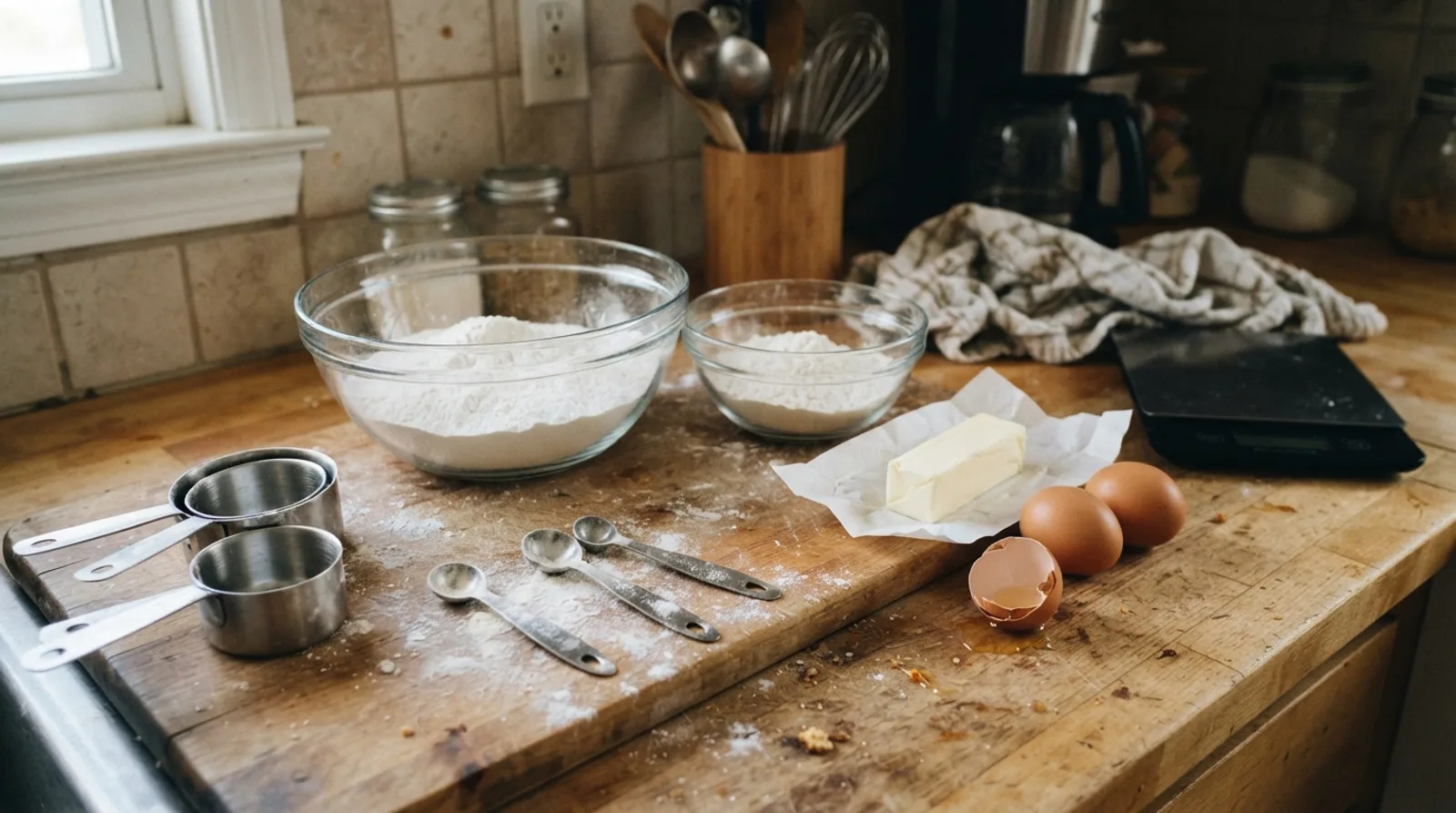
Pan size and bake time when you resize
A recipe bakes in a predictable time because the batter sits at a predictable depth. Keep the depth and the time barely changes, and to keep the depth, change the pan area by the same factor as the recipe. An 8 x 8 inch pan has 64 square inches, so a double batch wants about 128, and a 9 x 13 (117) is the closest common pan. For a half batch of a 9 x 9 recipe (81 square inches), King Arthur Baking suggests an 8½ x 4½ inch loaf pan (about 38). Pick your pans below.
Pan size converter
117 sq in ÷ 64 sq in = 1.83x
Double the recipe. It will sit a little deeper, so allow a few extra minutes.
Keeps the batter at the same depth, so the original bake time is your starting point. Check 5 to 10 minutes early in a bigger pan, and expect a longer bake if the batter ends up deeper.
- Making more: keep the oven temperature and check at the original time. A bigger batch takes longer to heat through, especially if it ends up deeper.
- Making less: set a timer for about half the original time, as King Arthur Baking suggests, then check every 5 minutes for cakes and quick breads and every minute or two for cookies.
- Pots and slow cookers: a doubled stew can overfill the pot. Tasting Table suggests filling a pot no more than about two-thirds full, so use a wider pot or cook in two batches.
How to cut a recipe in half
Halving is the most common conversion, and it only has three snags. First, the measures: half of ¾ cup is 6 tablespoons, half of ⅓ cup is 2 tablespoons plus 2 teaspoons, and half of ¼ teaspoon is ⅛ teaspoon (the halving chart covers the rest). Second, the odd egg, which you beat and weigh. Third, the pan: use one with about half the area, or bake the full recipe as smaller portions and freeze half. Select ½ in the converter to see a whole list halved at once.
For the opposite job, doubling a recipe for a crowd or a second tray, our guide on how to double a recipe goes deeper into bread, cookies, slow cookers and pressure cookers.
Converting metric recipes to cups (and back)
Recipes from the UK, Europe and Australia measure dry ingredients in grams and liquids in milliliters; American recipes use cups and spoons for both. Choose Cups and oz and the converter turns grams of flour, sugar, butter and the other ingredients in the chart into cups, and everything else into ounces and pounds. Choose Grams and ml to go the other way. Small amounts stay in teaspoons and tablespoons in both, because metric cooks use the same spoons.
Oven temperatures convert with a formula: multiply Celsius by 9, divide by 5 and add 32. Recipes round the results to the usual dial settings:
- 150°C is 302°F, written as 300°F
- 160°C is 320°F, written as 325°F
- 180°C is 356°F, written as 350°F
- 200°C is 392°F, written as 400°F
- 220°C is 428°F, written as 425°F
Multiply the ingredients, match the pan by area, and never multiply the clock.
Keep the converted recipe
If you make a recipe at the new size more than once, keep the converted list so you never redo the math at the counter. In CookEase, every saved recipe has a Serves control next to the ingredients: change it and every amount updates, including the amounts written in the steps, while the saved recipe stays as it was (here is how it works). In the iPhone and Android apps, the shopping list and grocery order you make from that recipe use the new amounts too, so you buy for the batch you are actually cooking.
Working out what a serving of your recipe adds up to instead? The recipe calorie calculator handles that, and our guide to writing a recipe shows how to set down the converted version so anyone can cook from it.
Resize any recipe with one tap.
Save a recipe from any link, set the servings you need, and shop and cook from amounts that already match your batch.