Recipe calorie calculator
Weigh the finished dish without the pot and add it above to get calories per 100 g and for the exact portion on your plate. How the cooked-weight method works
Per serving (1 of 6)
319 calories
- Protein
- 25.0 g
- Carbs
- 36.4 g
- Fat
- 10.1 g
- Fiber
- 10.4 g
Whole recipe
1,915 cal
150 g protein · 218 g carbs · 60.4 g fat
10 of 11 lines counted
Ingredients, matched to USDA foods
Counted Worth a check Not counted
1 tbsp olive oil
Olive oil · 13.5 g (USDA: 1 tbsp = 13.5 g)
119 cal1 large onion, diced
Onion · 150 g (USDA: 1 large = 150 g)
60 cal1 red bell pepper, diced
Red bell pepper · 119 g (USDA: 1 medium = 119 g)
31 cal3 cloves garlic, minced
Garlic · 9 g (USDA: 1 clove = 3 g)
13 cal1 lb lean ground turkey (93% lean)
Ground turkey (raw, 93% lean) · 454 g (1 lb = 454 g)
680 cal2 tbsp chili powder
Chili powder · 16 g (USDA: 1 tbsp = 8 g)
45 cal1 tsp ground cumin
Ground cumin · 2.1 g (USDA: 1 tsp, whole = 2.1 g)
8 cal1 (28 oz) can crushed tomatoes
Crushed tomatoes (canned) · 794 g (1 × 794 g, the size in the recipe)
254 cal2 (15 oz) cans kidney beans, drained and rinsed
Kidney beans (canned) · 850 g (2 × 425 g, the size in the recipe)
689 cal1 cup chicken broth
Chicken broth · 249 g (USDA: 1 cup = 249 g)
15 calSalt and pepper to taste
Table salt
No amount, so it is not counted. Salt to taste adds sodium the label cannot show.
--
Tap any field to start. The food list loads in a moment.
Nutrition estimate
6 servings per recipe
Serving size1/6 of the recipe
Amount per serving
Calories320
% Daily Value*
Total fat 10 g13%
Saturated fat 2.5 g11%
Sodium 890 mg39%
Total carbohydrate 36 g13%
Dietary fiber 10 g37%
Total sugars 11 g
Protein 25 g
Your recipe stays on this device, so it is here when you come back. Nutrition comes from USDA FoodData Central for each ingredient. It is an estimate, not a lab analysis.
Cooking this again?
Save it to CookEase and every recipe you save gets calories, protein, carbs and fat per serving, worked out for you. Change the servings and the numbers follow.
Paste a recipe the way you copied it: the title, the servings line, the ingredients and the steps. The calculator finds the ingredient list, reads amounts like 1 1/2, ½, 2-3 and 200g, and matches each line to a food in USDA FoodData Central, the government's nutrition database. Every line shows the food it picked and the weight it used, so you can see exactly where each number comes from and tap Change to fix anything.
The short answer
- To calculate the calories in a recipe, turn every ingredient into grams, multiply by its calories per 100 grams, add the lines up and divide by the number of servings. The calculator above does all of it from a pasted recipe.
- The sample turkey and bean chili comes to 1,915 calories for the pot, or 319 calories per serving for 6 servings, with 25 grams of protein, 36 grams of carbs, 10 grams of fat and 10 grams of fiber.
- Measure ingredients raw and count them with raw values. Weigh the finished dish only to divide it: total calories divided by the cooked weight gives calories per gram for any portion you scoop.
- Count the oil you cook with (a tablespoon of olive oil is about 119 calories), but not all of the oil you fry in, because only part of it stays in the food.
How to calculate calories in a recipe
Calculating the calories in a recipe takes three numbers per ingredient: how many grams went in, how many calories that food has per 100 grams, and how many servings the recipe makes. Everything else is adding up.
- 1
List every ingredient with its amount
Include what goes in the pan: the oil, the butter, the sauce and the cheese on top. These are the lines people forget, and they are often the most calorie-dense. - 2
Turn each amount into grams
Weighing is best. Otherwise convert with a standard weight for that food: USDA lists a cup of all-purpose flour at 125 grams, a large egg at 50 grams and a clove of garlic at 3 grams. - 3
Multiply by calories per 100 grams
Grams divided by 100, times the food's calories per 100 grams. Do the same for protein, carbs, fat and fiber. - 4
Add the lines up
The sum is the whole recipe. This is the number that does not change, however you serve it. - 5
Divide by servings, or by the cooked weight
Divide by the number of servings for equal portions. For portions you scoop by eye, weigh the finished dish and work per gram.
The hard part is never the arithmetic. It is step two: knowing that a cup of sliced onion weighs 115 grams but a cup of chopped onion weighs 160, or that a cup of brown sugar in an American recipe means packed, 220 grams, not loose. The calculator uses the USDA weight for the way the line describes the food, and says which one it used.
Worked example: turkey and bean chili
The calculator opens with a real recipe: a pot of turkey and bean chili that serves 6. Here is what it adds up to with USDA values, line by line.
1,915cal
the whole pot
10 ingredient lines counted
319cal
per serving
6 servings
25g
protein per serving
with 36 g carbs, 10 g fat, 10 g fiber
Source: USDA FoodData Central (SR Legacy) values for each ingredient of the sample recipe.
You can check any line by hand. One pound of raw 93% lean ground turkey is 453.6 grams, and USDA lists it at 150 calories per 100 grams: 453.6 ÷ 100 × 150 = 680 calories, the number the calculator shows on that line. The tablespoon of olive oil is 13.5 grams at 884 calories per 100 grams, or 119 calories, more than the onion, the bell pepper and the garlic put together.
Raw weight or cooked weight?
Both, for different jobs. Count the ingredients raw, because recipes give raw amounts and food values are listed that way. Then, if the portions will not be equal, weigh the finished dish once and divide by it. Mixing the two is the classic mistake: rice and pasta soak up water as they cook, and meat loses it.
365cal
100 g of white rice, dry
USDA FoodData Central
130cal
100 g of white rice, cooked
The same rice after it absorbs water
80cal
100 g of the sample chili
If the finished pot weighs 2,400 g
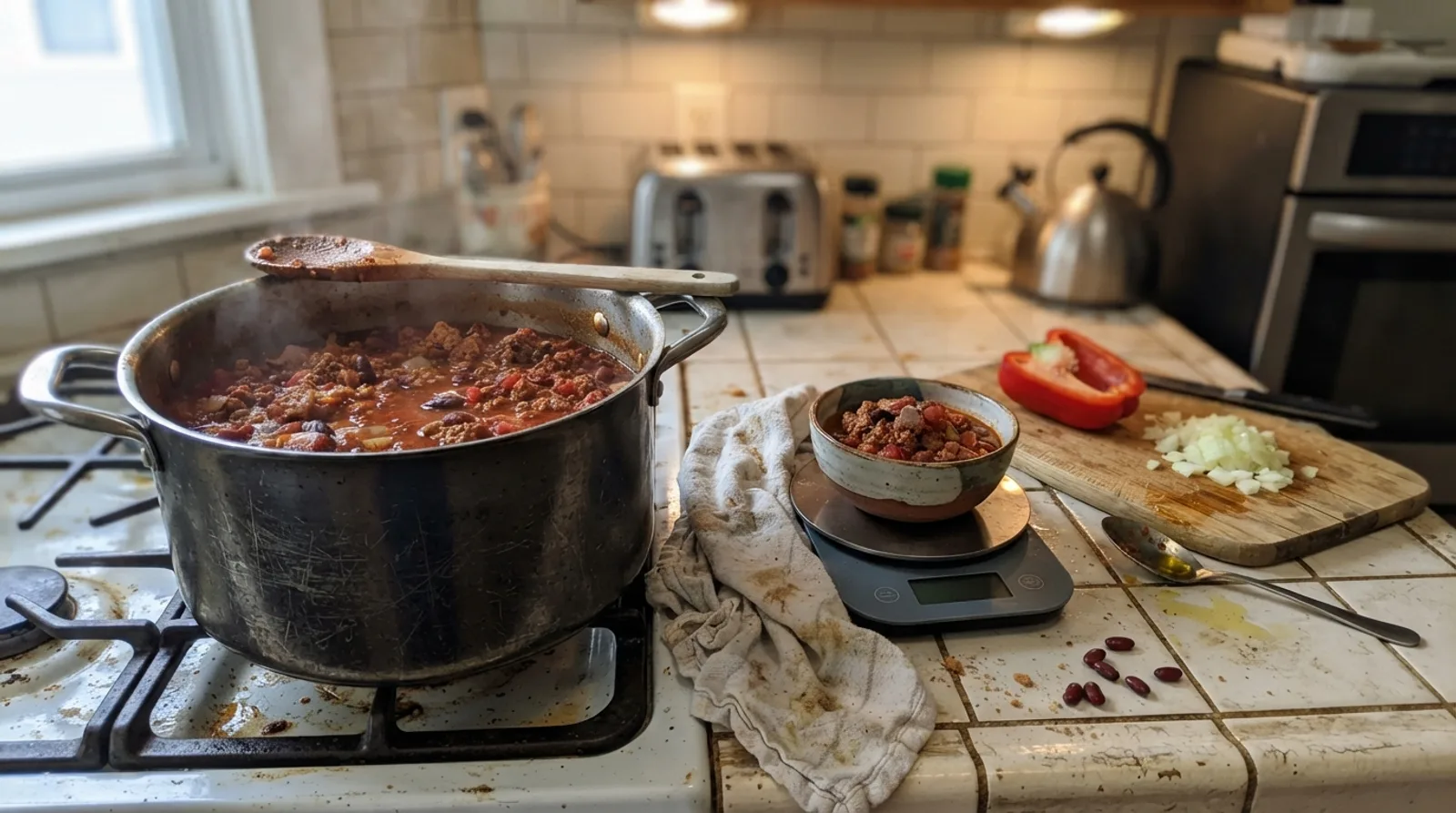
For the chili, say the finished pot weighs 2,400 grams without the pot. Then 1,915 ÷ 2,400 is about 0.8 calories per gram, 80 per 100 grams, and a 350 gram bowl is about 280 calories, whoever ladles it. Type the cooked weight into the calculator and it shows the per 100 g numbers and the numbers for any portion you weigh. Our guide to calculating calories in a homemade recipe walks through this cooked-weight method step by step, with the scale routine that makes it a ten-second job.
Oil, frying and the calories recipes hide
Fat carries about 9 calories per gram, more than twice protein or carbs, so small amounts of oil and butter move the total more than anything else on the list. A recipe that says "a drizzle" or "oil for the pan" gives you nothing to count, and those are exactly the lines worth measuring.
Count the whole bottle of frying oil
Weigh the oil before and after
That is why the calculator leaves a line like "vegetable oil, for frying" out and asks for the grams instead. Oil you cook with, like the tablespoon that softens the onions, is counted in full, because all of it ends up in the dish.
The other lines worth a second look
- Sauces and sweeteners: honey, maple syrup, bottled sauces and jam add carbs that are easy to skip.
- Toppings: cheese, sour cream, nuts and avocado are often listed under "to serve". Paste them too if you eat them.
- Liquids that stay in: coconut milk and cream count in full; water and plain broth barely register.
What the calculator does with tricky lines
Real ingredient lists are messy. Here is how each kind of line is handled, so you know what to check.
1 (15 oz) can kidney beans
- How it is counted
- The can size on the line: 425 g
- What to check
- Nothing, as long as the size is written
1 can black beans
- How it is counted
- Not counted until you add the size
- What to check
- Type the weight from the label
2 large eggs
- How it is counted
- USDA large egg: 50 g each
- What to check
- Nothing
2 chicken breasts
- How it is counted
- USDA average size, marked to check
- What to check
- Weigh them or use the package weight
1 cup (120 g) flour
- How it is counted
- The grams written in the recipe
- What to check
- Nothing
Salt to taste
- How it is counted
- Not counted: no amount
- What to check
- Add grams if you track sodium
2 sprigs thyme
- How it is counted
- Too little to change the numbers
- What to check
- Nothing
Oil, for frying
- How it is counted
- Not counted
- What to check
- Add the grams the food absorbed
| How it is counted | What to check | |
|---|---|---|
| 1 (15 oz) can kidney beans | The can size on the line: 425 g | Nothing, as long as the size is written |
| 1 can black beans | Not counted until you add the size | Type the weight from the label |
| 2 large eggs | USDA large egg: 50 g each | Nothing |
| 2 chicken breasts | USDA average size, marked to check | Weigh them or use the package weight |
| 1 cup (120 g) flour | The grams written in the recipe | Nothing |
| Salt to taste | Not counted: no amount | Add grams if you track sodium |
| 2 sprigs thyme | Too little to change the numbers | Nothing |
| Oil, for frying | Not counted | Add the grams the food absorbed |
When it cannot find a food, it says so instead of picking something close. Tap Fix, search the USDA list (more than 6,000 foods, the common ones first) and choose the right one, or type the weight in grams yourself. Your fixes stay with the recipe on your device.
A nutrition label for a homemade recipe
Under the ingredient list, the calculator draws a nutrition label for one serving. It follows the rounding rules for real nutrition labels in the U.S. (calories to the nearest 10 above 50, sodium to the nearest 10 milligrams above 140, fat to the half gram under 5 grams) and the FDA Daily Values, such as 78 grams of fat and 2,300 milligrams of sodium. That makes it easy to compare a homemade dish with something from the store.
It is still an estimate, worked out from average values for each ingredient, not a lab test, and it is labeled that way. It is meant for cooking and tracking at home, not for food you sell.
How accurate is it?
Accurate enough to track honestly, with errors you can see. The nutrition values come from the USDA SR Legacy release, the long-standing reference database behind most nutrition apps, and they are averages: one onion is not another, and brands of the same food differ. The biggest errors in any recipe calculator come from sizes it has to assume, like "1 onion" or "2 chicken breasts", which is why this one shows the weight it assumed on every line.
The fastest way to a better number is not a better database. It is a kitchen scale for the three or four ingredients that carry most of the calories.
Calories also will not match the 4/4/9 shortcut exactly, because USDA uses factors specific to each food, an approach the USDA Agricultural Research Service describes in its work on estimating calories. A few percent either way is normal. If two calculators disagree by much more, compare their weights line by line; the difference is almost always one ingredient.
Keep the numbers with the recipe
If you cook something more than once, you should not have to work it out again. In CookEase, every recipe you save, from a link, a video, a photo or pasted text, gets its calories, protein, carbs and fat per serving worked out for you, and they follow when you change the servings (here is how the numbers are made). To resize a recipe instead, the recipe converter doubles, halves or scales any ingredient list.
Every recipe you save, with its macros.
Save a recipe from any link or video and get calories, protein, carbs and fat per serving, ready when you cook.