
AI Nutrition Estimates vs. Package Labels: What Home Cooks Should Actually Trust
Your recipe app says 512 calories, the yogurt tub says something else. A clear-eyed guide to how AI nutrition estimates work, where labels mislead, and how to use both without obsessing.
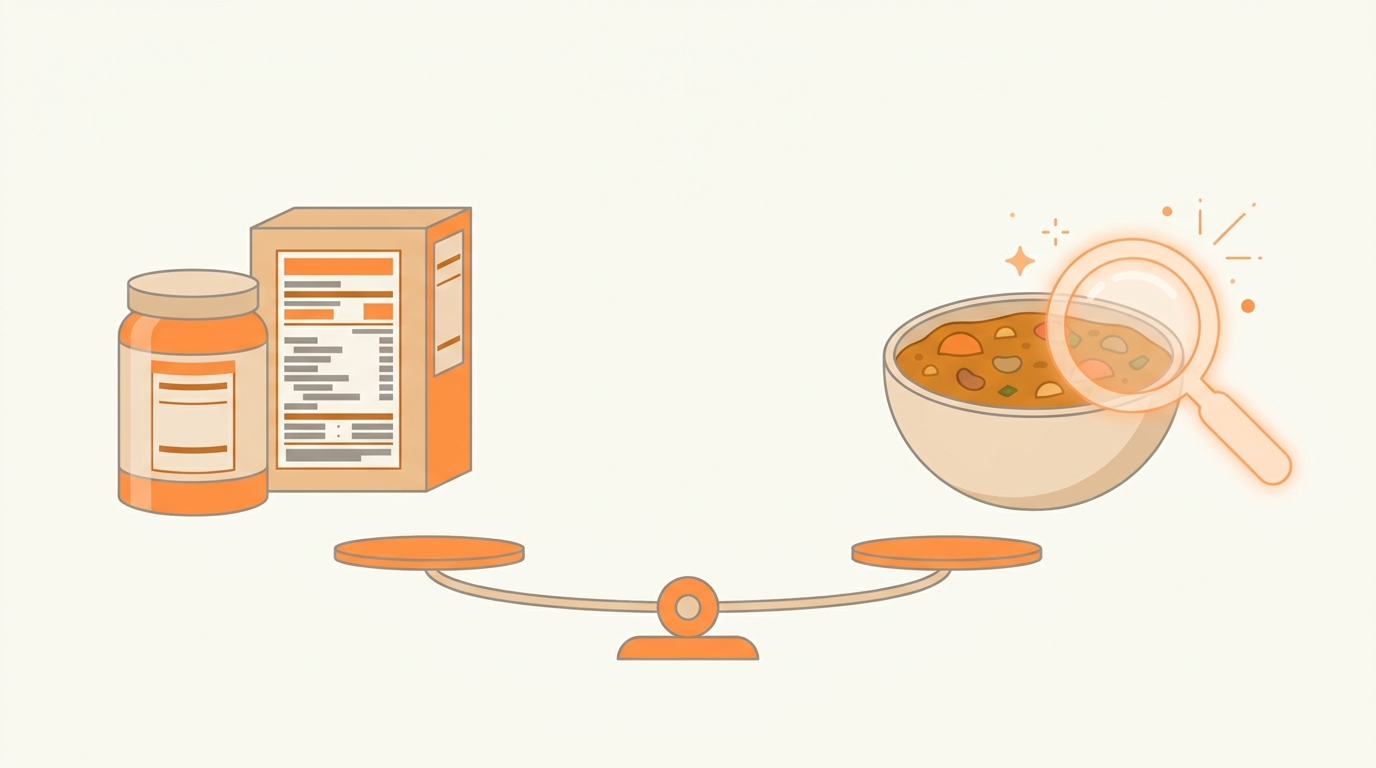
You cook a homemade curry, your app estimates 512 calories per serving, and a little voice asks: "Says who?" Meanwhile the frozen version at the store states its numbers with the full confidence of a government-regulated label.
Here is the uncomfortable truth: both numbers are estimates. Understanding how each one is produced, and where each one bends the truth, will make you a far better judge of what you're eating than blind faith in either. This guide breaks down the mechanics of AI nutrition analysis, the legal wiggle room built into package labels, and the trap of serving-size math that catches almost everyone.
How an AI Estimates Your Homemade Dinner
When an AI analyzes a recipe, it works from the ingredient list: it identifies each ingredient, maps it to known nutritional data, accounts for the quantity, sums the totals, and divides by the number of servings. Modern models are good at the hard parts that used to break older calculators, like understanding that "1 large onion, diced" weighs about 150 grams, or that half the oil in a marinade never makes it into your body.
In CookEase, this analysis produces per-serving figures for calories plus protein, carbohydrates, and fat down to a tenth of a gram, along with a plain-language description of what one serving actually is, "one bowl, about 1.5 cups," rather than leaving you to guess. That last part matters more than the decimals, as we'll see below.
The honest caveat: these are smart estimates, not lab measurements, and any good app says so. The AI cannot know that your "medium" sweet potato was a monster, or that you doubled the cheese because it was Tuesday. Natural variety in produce size, cooking losses, and a cook's improvisation means a homemade dish's true numbers sit in a band around the estimate, typically within 10-20%.
The Label Is Less Exact Than It Looks
Package labels project precision, but the rules behind them allow generous slack. In the US, the FDA permits actual calorie content to exceed the labeled value by up to 20% before a product is considered misbranded. Independent lab tests of packaged foods routinely find real-world deviations in that range. A "240 calorie" meal can legally deliver 288.
Then there is rounding: below certain thresholds, fat and sugar can be rounded down aggressively, which is how "0g trans fat" can legally sit on a product that contains some. The label's aura of certainty is largely typographic.
The real takeaway: An AI estimate for your homemade stew and the printed label on a frozen lasagna have surprisingly similar wiggle room. The difference is that with the homemade dish, you control the ingredients and can see exactly what went in.
The Serving-Size Trap: Where Everyone Actually Goes Wrong
Here is where most nutrition confusion really lives, and it has nothing to do with AI accuracy. "Per serving" numbers are only meaningful if you know what a serving is, and packaged food has a long history of defining servings nobody eats. The classic examples: a pint of ice cream listed as three servings, a small bag of chips as two, a bottled smoothie as two, when virtually every human consumes each in one sitting.
Home cooking has its own version of this trap. A recipe "serves 6," but your family of four finishes it. Congratulations: every per-serving number just silently inflated by 50%. No nutrition tool, AI or otherwise, can protect you from dividing a pot by the wrong number.
The fix is to anchor servings to something physical. A per-serving estimate attached to "one bowl, about 1.5 cups" is something you can act on; a bare "serves 6" is a suggestion. When you look at an AI analysis of your recipe, glance at the portion description first, before you look at a single number. If the described portion doesn't match how your household actually eats the dish, adjust the serving count and let the math follow.
The Wildcards Nobody's Database Captures
A few sources of variance affect homemade and packaged food alike, and no analysis method fully captures them. Cooking itself changes the math: water loss concentrates calories per gram, some starches become more or less available depending on how they're cooked and cooled, and the oil left in the pan never made it to your plate. Ripeness matters too; a green banana and a spotty one are different foods, nutritionally. Even lab-measured label values are averages across batches of a product that varies crop to crop and season to season.
None of this is a reason to give up on numbers. It's a reason to hold them lightly: useful, pointing in the right direction, and a little fuzzy around the edges. The people who get into trouble with nutrition numbers are rarely the ones using rough estimates thoughtfully; they're the ones treating any single number, printed or predicted, as gospel.
A Sensible Approach for Home Cooks
- Treat every number as a band, not a point. Whether from a label or an AI, read "512 calories" as "roughly 460-560." Decisions that survive that band, like choosing the higher-protein dinner, are decisions worth making.
- Get the serving size right first. It is the biggest source of wiggle in the whole picture, and the only one entirely within your control.
- Compare like with like. AI estimates shine for comparisons within your own cooking: this stir-fry vs. that pasta, this week vs. last. Any little quirks even out when the same app looks at both dishes.
- Stop chasing decimals. Figures to 0.1g are useful for tracking trends over time, not for believing your dinner contained exactly 34.2g of protein. Precision in the display is not the same as certainty in the world.
- Allergies and medical needs are different. If you're managing an allergy or a doctor-guided diet, always check the actual packaging and your care team's guidance. Estimates are for everyday awareness, not medical decisions.
Why Estimate Homemade Food at All?
Because the alternative is flying blind on exactly the meals that make up most of a healthy diet. People who cook at home eat better than people who don't, but they historically had the least nutritional visibility, since nobody laminates a label onto a pot of chili. AI analysis closes that gap: save a recipe into CookEase, and the same dish that used to be a nutritional mystery now carries a reasonable per-serving estimate you can compare, track, and act on.
The goal was never perfect numbers. The goal is enough visibility to notice that your favorite weeknight rotation is protein-light, or that the "healthy" muffins are a dessert. Estimates, used honestly, are more than enough for that.
See what's really in your cooking.
Save any recipe and get per-serving AI nutrition estimates with a portion description that makes sense.
Analyze Your First Recipe