The short answer
- Buy 1 pound of bone-in prime rib per person, about one rib for every two guests, or ¾ pound (one rib for about every three) when there are plenty of sides. Boneless needs half as much: about ½ pound a person.
- At 350°F a 2-rib, 4 to 6 lb roast takes 1¾ to 2¼ hours to medium-rare and a 4 to 5 rib, 8 to 10 lb roast 2½ to 3 hours. Take it out at 135°F and rest it 15 to 20 minutes.
- For a reverse sear, roast it at 250°F for about 3½ to 4 hours until the center reads 130°F, rest it 30 minutes to 1½ hours, then sear it at 500 to 550°F for 6 to 10 minutes and carve.
Prime rib calculator
What do you know?
Cut
Appetite
Method
Doneness
For 8 guests
Buy a 4-rib roast, about 8 lb
8 × 1 lb = 8 lb, rounded up to whole ribs at about 2 lb a rib.
Cooking time: 2 hr 30 min to 3 hr at 350°F.
Your plan for Christmas Day, Dec 25
6:00 pm
Thu, Dec 24
Salt it
Salt all over and leave it uncovered on a rack in the fridge (1 to 4 days ahead)
1:40 pm
Fri, Dec 25
Take it out of the fridge
Season it while the oven heats. Never more than 2 hours out of the fridge.
2:10 pm
Heat the oven to 350°F
So it is fully hot when the roast goes in
2:40 pm
In the oven
2 hr 30 min to 3 hr at 350°F
5:10 pm
Start checking the temperature
In the thickest part, away from the bone
5:40 pm
Out at 135°F
Tent with foil. It climbs to about 145°F as it rests.
6:00 pm
Carve and serve
After a 15 to 20 minute rest
CookEase keeps the recipe from any site or video, works out its nutrition, puts the dinner on your Meal Plan and turns the sides into one grocery list. Free to start.
The box answers the two questions every prime rib dinner starts with. Tell it who is coming and how hungry they are, and it says how many ribs and pounds to ask the butcher for. Or tap I have a roast and put in the weight on the label to see how many people it feeds. Then pick the method and the doneness, and it counts back from your dinner time: when to salt the roast, when it comes out of the fridge, when it goes in, when to start checking it, when it comes out and when to carve. Print my prime rib plan puts that timeline on the fridge door.
How much prime rib per person
Plan on 1 pound of bone-in prime rib for each guest. That is the amount most guides use, and it lines up with the rule the beef council's holiday roasting chart gives butchers: one rib for every two people, with each rib weighing about 2 pounds. Serious Eats points out that a pound a person is for very hungry eaters, and that most tables get away with ¾ pound, or about one rib for every three people. So the box has two settings:
- Hearty: 1 lb a person, bone-in. Big eaters, a meat-first table, or a few slices left for sandwiches the next day.
- Light: ¾ lb a person, bone-in. A table with plenty of sides, older guests or a lot of kids.
- Boneless: half as much. A boneless ribeye roast has no bones to pay for, so Tasting Table halves the order: about ½ pound a person, or ⅜ pound for a light table.
The box rounds a bone-in roast up to whole ribs, because that is how a butcher cuts it, and never sells you fewer than two. A whole rib section has seven ribs, so a crowd that would need more than that gets two roasts, which also cook faster and fit a home oven better than one giant one.
| Guests | Bone-in | Boneless |
|---|---|---|
| 2 | 2 ribs, 4 lb | 2 lb |
| 4 | 2 ribs, 4 lb | 2 lb |
| 6 | 3 ribs, 6 lb | 3 lb |
| 8 | 4 ribs, 8 lb | 4 lb |
| 10 | 5 ribs, 10 lb | 5 lb |
| 12 | 6 ribs, 12 lb | 6 lb |
| 14 | 7 ribs, 14 lb | 7 lb |
| 16 | 2 × 4 ribs, 16 lb | 8 lb |
| 20 | 2 × 5 ribs, 20 lb | 10 lb |
How much prime rib for 8, 10 or 12 people
- 8 people: a 4-rib roast, about 8 lb. With plenty of sides, a 3-rib roast of about 6 lb.
- 10 people: a 5-rib roast, about 10 lb, or a 4-rib roast of about 8 lb for a light table.
- 12 people: a 6-rib roast, about 12 lb, or 5 ribs for a light table.
How long to cook prime rib
At 350°F, a bone-in prime rib of 2 ribs (4 to 6 pounds) takes 1¾ to 2¼ hours to reach medium-rare, and a roast of 4 to 5 ribs (8 to 10 pounds) takes 2½ to 3 hours, according to the beef council's chart. Medium takes about half an hour longer. A big roast needs fewer minutes per pound than a small one, because heat reaches the center of a thick roast from every side at once, so a 10 lb roast does not take twice as long as a 5 lb one.
The USDA's holiday roasting chart uses a lower oven, 325°F, and gives 23 to 30 minutes a pound for a 4 to 8 lb bone-in rib roast and 39 to 43 minutes a pound for a 4 lb boneless one. Both charts are starting points: ovens run hot or cold, a roast straight from the fridge takes longer than one that sat out, and the bone slows the meat next to it. The thermometer decides when it is done.
| Weight | Medium-rare |
|---|---|
| 4 lb | 1 hr 45 min to 2 hr 15 min |
| 5 lb | 1 hr 45 min to 2 hr 15 min |
| 6 lb | 1 hr 45 min to 2 hr 15 min |
| 7 lb | 2 hr 5 min to 2 hr 40 min |
| 8 lb | 2 hr 30 min to 3 hr |
| 9 lb | 2 hr 30 min to 3 hr |
| 10 lb | 2 hr 30 min to 3 hr |
| 12 lb* | 3 hr to 3 hr 40 min |
| 14 lb* | 3 hr 30 min to 4 hr 15 min |
| 16 lb* | 4 hr to 4 hr 50 min |
Prime rib temperature chart
A big roast keeps cooking after it leaves the oven: the hot outside keeps pushing heat to the center. So you take it out before it reaches the doneness you want, and the rest finishes it. The beef council pulls a classic roast at 135°F for medium-rare and lets it rise to about 145°F over a 15 to 20 minute rest; for medium it pulls at 145°F and ends near 160°F. A reverse-seared roast comes out of a 250°F oven with much less heat stored in its outer layers, so it barely climbs, and Serious Eats takes it out at the temperature it will be served at: 120 to 125°F for rare, 130°F for medium-rare and 135°F for medium.
| Doneness | Reverse | Classic | Rested |
|---|---|---|---|
| Rare | 120 to 125°F | - | - |
| Medium-rare | 130°F | 135°F | 145°F |
| Medium | 135°F | 145°F | 160°F |
Put the thermometer in the thickest part of the roast, in the center, not touching a bone or sitting in fat. Check in two places on a big roast; the ends cook faster than the middle, which is handy when some guests want theirs more done.
Reverse sear prime rib, step by step
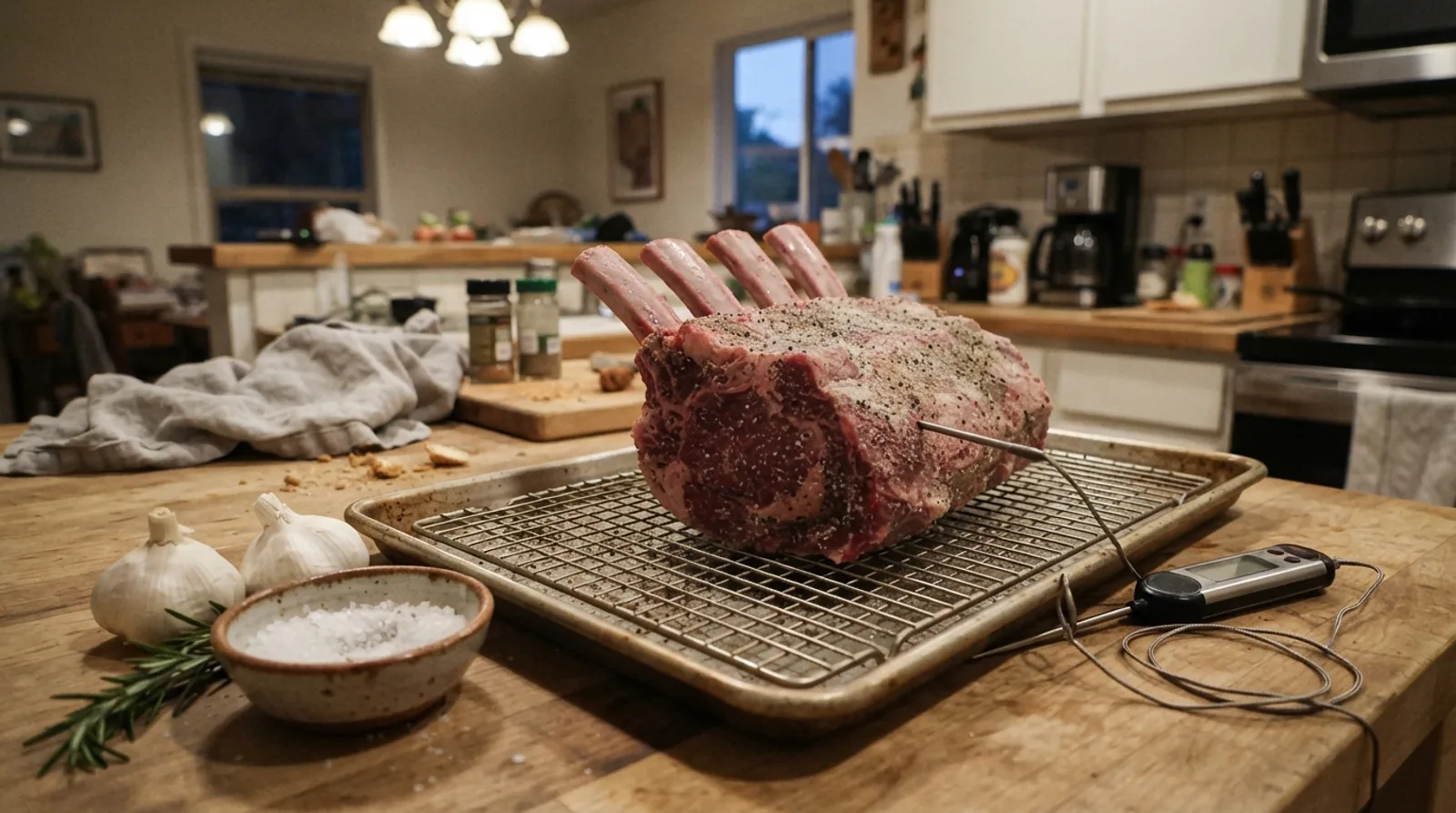
The reverse sear flips the usual order: the roast cooks slowly first and gets its crust last. J. Kenji López-Alt's method at Serious Eats is the one most cooks follow, and it is what the calculator plans when you pick Reverse sear:
- Salt it ahead. At least a day before and up to four days ahead, salt it all over and leave it uncovered on a rack in the fridge.
- Low oven. Heat the oven to 250°F (or as low as it goes, from 150°F) and roast it fat side up on a rack until the center reaches your pull temperature. At 250°F that takes about 3½ to 4 hours.
- Long rest. Tent it with foil and let it rest for at least 30 minutes and up to 1½ hours. Turn the oven up to 500 to 550°F meanwhile.
- Sear. About 10 minutes before you eat, put it back in the hot oven for 6 to 10 minutes, until the outside is deep brown and crisp.
- Carve right away. No second rest: only the very outside got hot.
The long rest is what makes the reverse sear easy to time. If the roast reaches its temperature early, it simply rests longer, and Serious Eats found a foil-covered roast stays warm for over an hour. The calculator plans an hour of rest, so a roast that runs half an hour fast or slow still lands on time.
A classic prime rib timeline for Christmas dinner
Here is the plan the box shows by default: 8 guests, a 4-rib bone-in roast of about 8 lb, roasted at 350°F to medium-rare, for dinner at 6:00 pm on Christmas Day.
- The day before, 6:00 pm: salt the roast and leave it uncovered in the fridge.
- 1:40 pm: take it out of the fridge and season it. The USDA says no perishable food should sit out more than 2 hours.
- 2:10 pm: heat the oven to 350°F.
- 2:40 pm: in the oven.
- 5:10 pm: start checking the temperature.
- 5:40 pm: out at 135°F, tented with foil.
- 6:00 pm: carve and serve.
The plan starts the roast early enough for the long end of the cooking time. If it reaches 135°F sooner, take it out then and let it rest a little longer under loose foil; you get the oven back for the sides.
Bone-in or boneless prime rib?
Bone-in is the classic: the bones act as a built-in rack, shield the meat next to them from the heat and make a roast that looks like a holiday. Serious Eats prefers bone-in for that reason, since the bones give you more evenly cooked meat. Boneless is easier to carve and to fit in a small oven, and you pay only for meat, which is why you need about half the weight.
Buy the roast up to 3 to 5 days before you cook it (the USDA's fridge time for a fresh beef roast), or ask the butcher to hold it. Leftover prime rib keeps 3 to 4 days in the fridge or 2 to 3 months in the freezer, according to the USDA. Slice it cold for sandwiches; reheated slices go gray fast.
Plan the rest of the holiday dinner
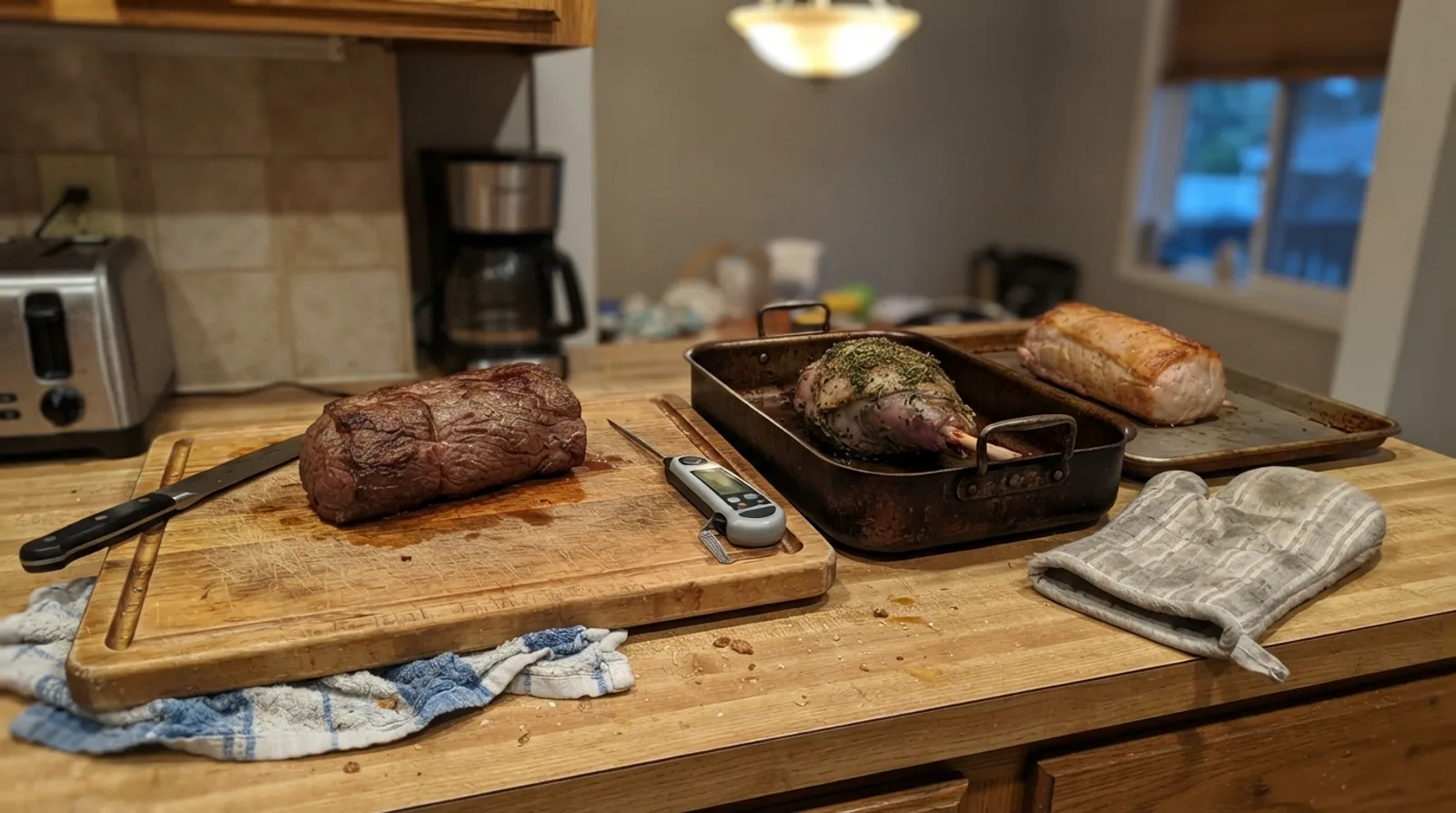
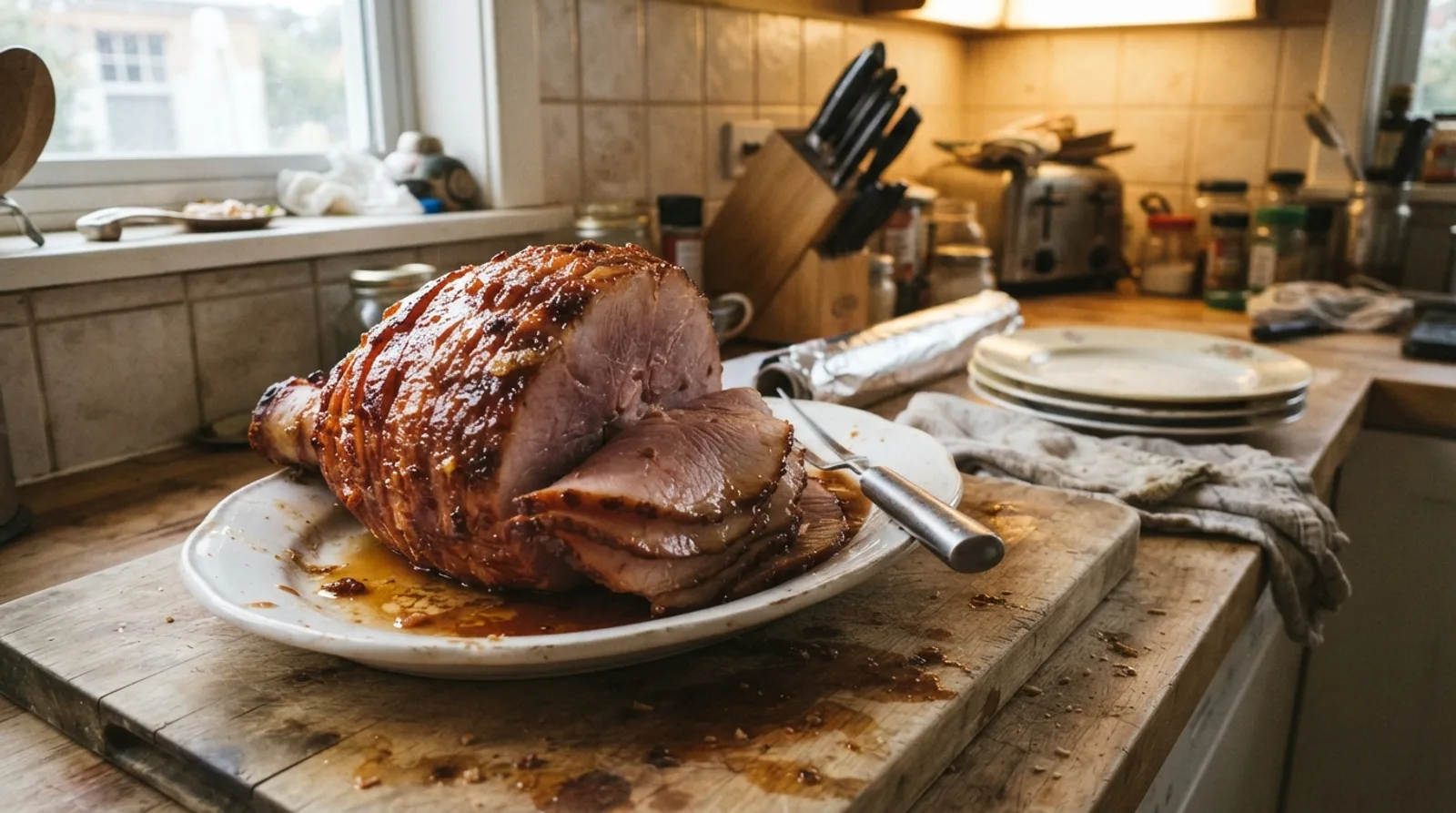
A roast is one dish of many. If ham is on the table too, the ham calculator sizes it for the same crowd, and our roast cooking times page covers beef tenderloin, leg of lamb and pork loin with the same dinner timeline. To scale your side dish recipes to the crowd, use the recipe converter.
CookEase keeps all of it together: save your prime rib recipe from any site or video, see its nutrition worked out per serving, put the dinner on your Meal Plan for the day, and turn every recipe for the meal into one grocery list sorted by aisle.
Your holiday recipes, in one place.
Save the roast and the sides from any site or video, put the dinner on your Meal Plan and shop from one list.