
The Save-to-Cook Gap: Why Your 400 Bookmarked TikTok Recipes Never Make It to Dinner
Saving a recipe video takes one tap. Cooking it almost never happens. Here is the psychology behind the save-to-cook gap and a simple pipeline that actually gets viral recipes onto your table.
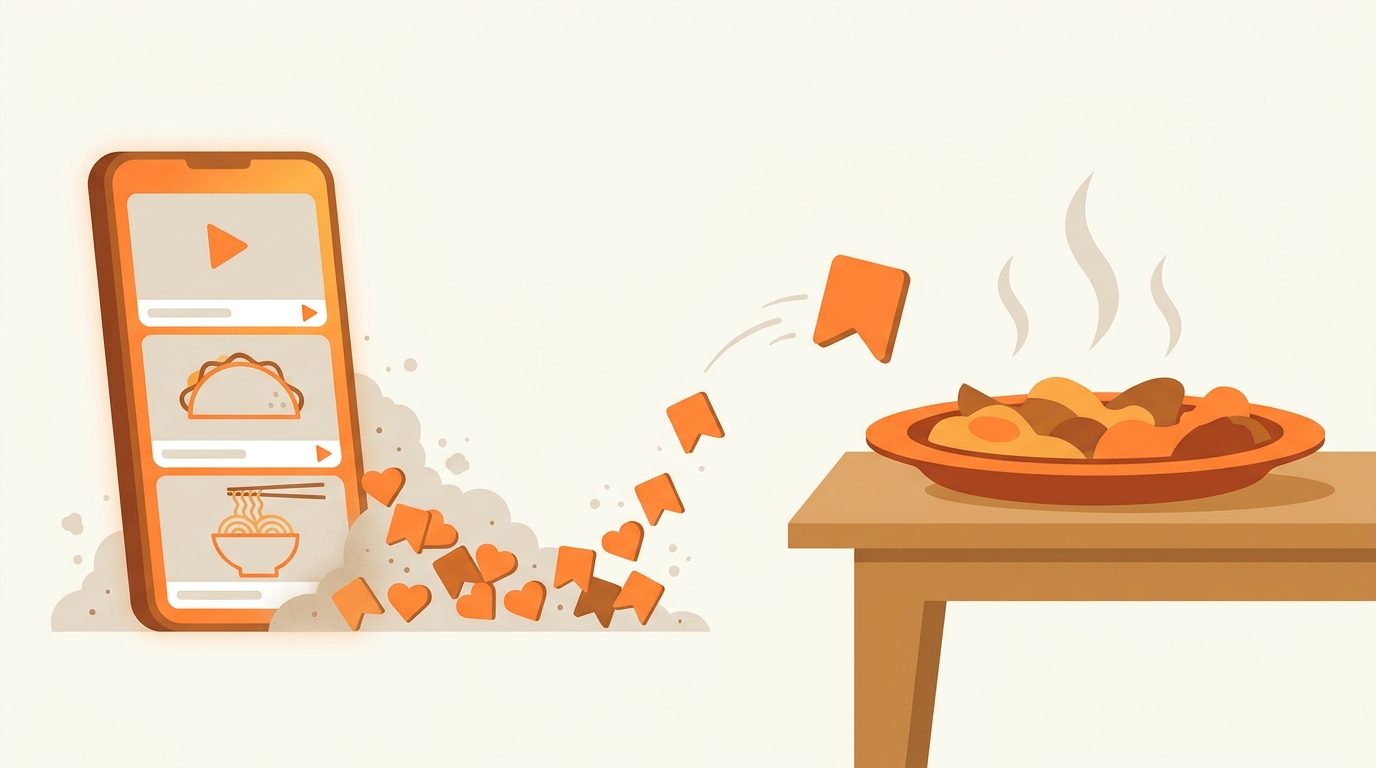
Open your TikTok favorites right now. How many recipe videos are in there? Fifty? Four hundred? Now the harder question: how many have you actually cooked?
If the answer is "almost none," you are not lazy and you are not unusual. The save button is doing exactly what it was designed to do, and cooking dinner was never part of that design. Understanding why saved recipes die in your bookmarks is the first step to building a pipeline where viral inspiration reliably becomes food.
Saving Is a Feeling, Not a Plan
Behavioral researchers call it the "intention-action gap." Tapping save delivers a small hit of accomplishment: you have "dealt with" the recipe, filed it away, made it yours. The emotional loop closes at the moment of saving, which is precisely why nothing happens afterward.
Worse, the save happens at the moment of maximum motivation: you just watched a 30-second video of glossy, perfectly lit birria tacos. Actually cooking requires motivation at a completely different moment, a random Tuesday at 5:40pm when you're tired and the fridge is half empty. The bookmark does nothing to carry motivation from moment one to moment two.
The Bookmark Is Not a Recipe
Even when Tuesday-you does open the favorites folder, you hit the second wall: a saved video is not a usable recipe. To cook from it you must rewatch it, pause at the ingredient shots, guess at the quantities the creator said out loud but never wrote down, and scroll a caption that may or may not list amounts. Researchers who study habits would say the task simply takes too much effort to start, and too-hard-to-start is where good intentions go to die.
Compare that to a cookbook: ingredients listed with quantities, steps in order, everything scannable in ten seconds. The format gap between "video I liked" and "instructions I can follow" is the single biggest reason the save-to-cook conversion rate hovers near zero.
The 30-second fix: The moment you save a video, share it to a recipe organizer instead of letting it rot in favorites. When you send a TikTok or Instagram link to CookEase, the AI reads the caption and looks at the video itself to rebuild the full recipe: a title, an ingredient list, and numbered steps. For YouTube cooking videos, it can go even deeper, drawing on the transcript to capture details the creator only said out loud. Either way, the result is the same: a cookable recipe instead of a bookmark.
Your Favorites Folder Has No Memory
The third failure is retrieval. Social apps sort saves chronologically, which means the pasta you saved in January is buried under ninety videos of everything else you have saved since. There is no search by ingredient, no grouping by meal type, and no way to answer the only question that matters on a weeknight: "What can I make with what I have?"
A recipe library flips this. Once saved, recipes can be grouped into cookbooks ("Weeknight," "Trying This Weekend," "Actually Made and Loved") and searched in a heartbeat, because now they're real recipes instead of videos. The recipe you saved in January is exactly as findable as the one you saved yesterday.
Why the Platforms Will Never Fix This
It's tempting to wait for TikTok or Instagram to build a real recipe feature, but consider their incentives. A social platform is paid in minutes of attention. The moment you leave the feed to go cook, the session ends, so every design choice optimizes for "watch one more video," not "close the app and preheat the oven." The save button exists to reassure you that leaving isn't necessary: you can always come back. You just never do.
This is not a conspiracy; it's just what the business model rewards. The practical conclusion is that the bridge from feed to kitchen has to live outside the feed, in a tool whose incentive is that you actually cook. Once you accept that, the path becomes obvious: the platform is for discovery, and everything after discovery happens somewhere built for cooking.
There's also a quality filter hiding in this handoff. Viral recipe videos are made for the same thing the platform is: watchability. Cheese pulls, dramatic pours, and 40 cloves of garlic make great footage and, sometimes, mediocre dinner. When a video is converted into a plain ingredient list and steps, stripped of the soundtrack and the jump cuts, you can finally evaluate it the way you'd evaluate any recipe. A surprising number of saves don't survive that sober second look, and that's the system working: better to filter when you save than at the dinner table.
Building the Save-to-Cook Pipeline
Here is a system that turns the save-to-cook rate from roughly 2% into something closer to weekly reality:
- Capture at the moment of inspiration. Share the video link to your organizer immediately. Ten seconds now saves a fifteen-minute rewatch-and-type-it-out session later, and most importantly it turns the video into a recipe you can cook from.
- Curate weekly, not never. Once a week, skim your saved recipes and move two or three into a "This Week" cookbook. Deciding when a recipe gets cooked is the step bookmarks skip entirely.
- Bridge to groceries. Add those chosen recipes' ingredients to a shopping list. A recipe whose ingredients are already in your fridge has crossed the biggest remaining barrier to being cooked.
- Make the cooking part easier too. When you do cook, use a step-by-step cooking mode rather than scrubbing video. In CookEase, hitting "Start Cooking" walks you through one step at a time, hands-free if you want it.
Let Most Saves Go
One final reframe: not every save deserves to be cooked. Some videos you saved for the vibes, and that's fine. The goal is not to cook all 400. The goal is that when a recipe genuinely excites you, there is an easy, natural path from "that looks incredible" to "that's what we're having Thursday." Separate the aspirational saves from the actionable ones, and give the actionable ones a real pipeline.
The creators making these videos want you to cook their food. The platforms just never built the bridge. Build it yourself, and your favorites folder stops being a graveyard.
Turn a bookmark into dinner.
Paste your most recent saved TikTok and get a clean, cookable recipe in seconds.
Save Your First Video Recipe